
The video is a riveting account of a village in Mustang which had to be moved due to the drying up of the glaciers. Masterminded by the French charity Bessin de Nepal . https://video.nationalgeographic.com/video/science/00000172-b382-d017-a972-bbb3aee70000?fbclid=IwAR1hh4meDNIOlTpHpy9c_sZwdOwX6PGWwFuJ_iYIm7EwsNHxdHOjm2fn69U
Latest on Corona Virus in Nepal
Snow Cat Travel
Lockdown in Nepal now remains until at least June 2nd,

THE EXPLORERS’ GRAVEYARD LEH LADAKH

Sven Hedin, the Swedish explorer, during his stay in Leh, on his way to Tibet (1900-1901), wrote that he had found five graves in the little graveyard – at the back of the Residency- two were directly linked to the Central Asian Trade Route. One belonged to the trader Andrew Dalgleish, who was murdered on the Karakorum pass, and another was the geologist, Ferdinand Stoliczka, who had travelled with the second Forsythe Expedition from Kashmir to Kashgar (1874), and had died of altitude sickness.
Although many of the deceased, especially the Moravian missionaries and Ferdinand Stoliczka, paleontologist have interesting stories, I felt that one should have special attention, namely the one dedicated to Andrew Dalgleish. This charismatic character was not only a Central Asian trader; he was also an adventurer, an explorer, a trader, and a spy for the British. His place in history deserves to be recorded.
Andrew Dalgleish, born 1853 in Edinburgh, was employed by Robert Shaw as an agent for the newly formed Central Asian Trading Company. In the summer of 1874, Dalgleish took his first consignment of goods for the company through the Karakorum pass from Leh to Yarkand in Chinese Turkestan. It was known as the worst travel route in the world and not for the faint hearted. When the venture failed, Dalgleish decided to continue trading on his own because he had married a local Muslim girl and had established his home in Yarkand. Being the only Englishman there, he was useful to the British, in keeping a watchful eye on the Russian Consul, Nicolai Petrovsky, who dominated the political scene in Kashgar.
Dalgleish was an avid explorer and he had accompanied Mr Casey of the Indian Civil Service, on an expedition from Kokonor to Tasidan in North Tibet. He was able to disguise himself as a local and spoke fluent Turki and Tibetan. When the Chinese armies advanced on Yarkand in1877, he was asked by the Muslims to act as their leader against the invaders. He refused, because he felt that showing partiality to either side would be ruinous for his business. The Moslems distrusted his reasons and suspected him of collusion with the Chinese.
Dalgleish appeared to be unaware of any possible danger when in April 1888, he made what was to be his last and fatal journey from Leh to Yarkand, Camping for the night on the night of the 8th, on the Karakorum pass, he was joined by an Afghan trader from Leh, named Daud Mohammad, whom he recognized. Desperate for money, the trader asked Dalgleish for a substantial loan which was refused. The Afghan was furious, grabbing his gun, aimed it at Dalgleish’s tent and fired. Dalgleish staggered outside, blood pouring from his shoulder but he was no match for his assailant. Weakened by this loss of blood, only slightly built and unarmed, he did not stand a chance. The Afghan raised his knife and Dalgleish died.
Robbery was the popular theory for the murder but it could have been a contract killing, as Dalgleish had many enemies both Chinese and Russian. Daud Mohammad escaped and fled through Central Asia, pursued by Lieutenant Hamilton Bower of the Indian Army, who cornered him in a Tashkent market, where he was arrested by the Russians. Before he could be extradited and brought to trial, the Afghan hanged himself in his cell and the motive for Dalgleish’s murder went with him to the grave. The remains of Dalgleish were rescued before they suffered the fate of the others who had died on the Karakorum pass and whose bones were left to bleach in the snow. He was interred in the Explorers’ Cemetery at Leh. His death was also commemorated on the pass by a small marble pillar with an inscription.
Years later, I visited Kashgar – Yarkand was off limits to foreigners – I found that the old British Embassy was now a flop house for migrant Pakistanis, and the former Russian Embassy had been converted into a hotel that had seen better days. Making an excuse – I wanted to use the bathroom – I gained access to the hotel. With its heavy furnishings of dark wood and deep red velvet curtain and cut glass chandeliers it was redolent of the Romanoffs. I could feel the Russian presence.
Of Dalgleish, there was no sign.
No, I wasn’t allowed to go along the old trade route over the Karakorum pass, no such luck. Instead, I travelled through Pakistan along the Karakorum–Kashgar highway over the Khunjerab pass, one of the hairiest and most dangerous roads in the world. 810 Pakistanis and 82 Chinese workers died during the construction mainly due to avalanches.
The graveyard has been renamed the Moravian Memorial Park.
Latest on Corona Virus in Nepal
Nepal remains under lockdown and international flights banned until at last May 15th. Presently it’s difficult to predict when and how Himalayan treks and adventure travel might realistically be able to return and what a “new normal” may be. Perhaps not for some considerable time as there are so many factors and uncertainties on an unprecedented global scale. We’re hibernating until then. So, stay safe and be kind to one another. Better days will come.
DREAMS OF KATHMANDU


Latest on the Corona Virus in Tibet
Four provinces of western and northwestern China historically populated by Tibetans — Gansu, Qinghai, Sichuan and Yunnan — have confirmed 140 cases of coronavirus, official media reported Tuesday as the Tibetan capital Lhasa’s airport began screening passengers from Wuhan.
The China Tibet Broadcasting website reported that as of Jan 27, Sichuan confirmed 90 cases of coronavirus, Yunnan reported 26, Gansu reported 19 positive tests, and Qinghai identified six cases. Four of the Gansu patients were in critical condition, it said/
The Lhasa-based state broadcaster did not reveal whether the patients are ethnically Tibetan or Han Chinese, but said they were being treated at designated hospitals.
Lhasa is the capital of the Tibet Autonomous Region (TAR), where no cases of coronavirus infection have been confirmed.
The number of confirmed cases of illness caused by the novel coronavirus, officially termed nCoV-2019 (Wuhan) by the World Health Organization (WHO), rose to 4,409 in China on Tuesday, with the majority still clustered in Hubei, according to a website set up by researchers at Johns Hopkins University to track the epidemic. The number of deaths in the epidemic rose to 107.
A Lhasa resident said “passengers and travelers arriving from Wuhan at Gonggar airport in Lhasa are singled out for physical screening and are kept under close observation for any display of the symptoms.”
The state-owned Tibet Daily and Communist Party mouthpiece People’s Daily reported that any passengers arriving in Lhasa by air or rail planes are kept in designated zones under close observation for 14 days, with anyone showing symptoms of coronavirus required to be rushed to designated hospitals in Lhasa.
All expenses, including food and accommodations must be borne by the passengers, the reports said.
The Lhasa resident described empty streets and light traffic at key Buddhist temples.
“Most teashops and restaurants are all closed down, and there are many people on duty to prevent any gathering of crowds all over Lhasa, in an effort to prevent the spread of the infection,” he told RFA.
“Beginning from Jan 27, any travelers arriving in Lhasa are required to remain in hotels for 14 days, and had to undergo a thorough physical checkup,” said another source in the capital.
Lhasa City’s Bureau of Culture Relics has ordered the closing of cinemas, clubs, and internet cafes, and the Lhasa Tourism Development Bureau has told city guest houses and hotels—except for those designated by the TAR government as “emergency hotels”—to shut down by Jan. 29.
In Lhasa, major public gathering sites such as the Jokhang temple, the Potala Palace, and the Norbulingka—summer home of exiled Tibetan spiritual leader the Dalai Lama—were closed on Monday.
A Tibetan in Zachuka in eastern Tibet told RFA that roads in the area were blocked.
“I am in Zachuka and now the road to and back from this area is closed to traffic and travelers,” he said.
“Tibetans who are well informed about the disease are taking proper precautions, but there are many other Tibetans who are not so well informed,” the man said, adding that the government is not handing out any face masks to people.
Dhalaugiri at Sunrise

The golden mountain at sunrise from Thasang Lower Mustang. I was far too lazy to get up when dawn was breaking but saw this spectacular scene just a little later before we headed north to Kagbeni and the restricted zone.
The Ghost Eater at Kagbeni
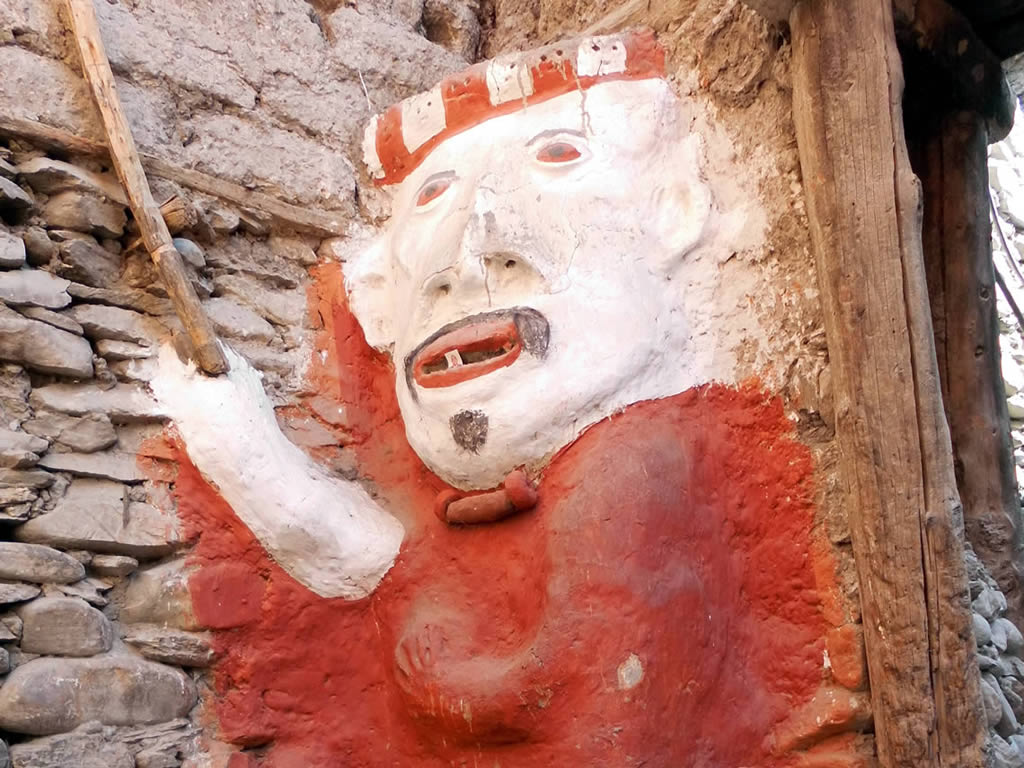
We went sightseeing, in the afternoon and found the Keni or Ghost Eater statue that guards the Kagbeni North Gate. A fearsome figure, he is endowed with an extraordinary large set of male genitals (click here to see full image). A female Ghost Eater with large orange-nippled breasts guards the South Gate. It is debatable whether these effigies are remnants of the pre-Buddhist religion, Bon-Po or are of the animistic traditions. They are strategically placed, to eat all the ghosts who might dare to enter the town. Zombies also have a difficult time because the doors are deliberately made small and they can’t pass through them because they are unable to bend. Every time they attempt to enter, they crack their heads on the door frames.
Humanist Symbols

Lo Gekar monastery was the highlight of my journey, a blessing was said for my welfare by the resident monk and I felt tears come to my eyes as I realised that I had finally reached this place.
The humanist symbols are from the time that animism, the worship of spirits in the trees and mountains was practiced in Mustang. The religion is pre-Bonpo and pre-Buddhism.
Prayer Flag Pole

Thrilled to be at Lo Gekar monastery, I tied my white katak at the base of the prayer flag in the courtyard hoping it would bring me good luck.
Prayer Flags in the Wind

Raj our guide is joining my prayer flags from Ladakh to the others at Lo Gekar. I brought them with me as a ‘Thank you’ to the benefit I have received from the blessing at Lo Gekar.
They will also bring benefit to my adopted family in Leh who gave them to me.
The Border between Mustang and Tibet

Today, we headed to the Tibetan border. This was totally against all the rules but I did so want to see Tibet that we decided to bend them just a little bit. I was once told by an Indian guide, in the Himachal Pradesh, that rules on paper only become rules when you get caught. The Kora La is the gateway, between Tibet and Western Nepal. Sven Hedin, the explorer, crossed this border into Mustang in 1905; he travelled as far as the village of Garphu, a short way from the checkpoint. He did not stay long, because he was running short of money, having only enough for two more days. Secondly, he had no knowledge about whether the Nepalese were hostile or friendly. Finally, he turned round and went back to Tibet, because he was afraid if he stayed away for too long, he would be refused admittance back into the country.
The Bon Monastery at Kewzing in Sikkim

This Tibetan folk religion has many beliefs which predate Buddhism and encompasses indigenous beliefs and animism practices. These are primarily concerned with propitiation of the spirits and demons of Tibet, which are believed to inhabit all areas of the country. Folk religious practices rely heavily on magic and ritual and are generally intended to bring mundane benefits, such as protection from harm, good crops, healthy livestock, health, wealth, etc. I was fortunate to be allowed to photograph the interior of the monastery when I visited in May 2017. There are only two Bon monasteries in India the other is in the Himachal Pradesh.
Lunch at a farmhouse in Haa Bhutan

I had the chance of visiting a farmhouse in the Haa district also known as Hidden-Land Rice Valley in the west of the country on the Tibetan border.
There is a large Indian military presence here because of the incursions by the Chinese. The farmhouse is also a homestay guest house.
I found many similarities with the houses in Ladakh India, but there were some surprises. I found a western bathroom and Tibetan-style bedrooms which looked comfortable with colourful mattresses and cushions laid out on the floor.
The lunch was delicious and I ate so much that I had to be helped down the ladder style staircase.
Lumbini Nepal 2016

This intrepid traveller was in Lumbini in search of the birth place of Buddha in the south of the country. I am happy to say she succeeded in her aim.
The place was full of pilgrims from all over Asia queuing to venerate the actual birth place which is housed in a large building. I had hoped for a moment of enlightenment but nothing happened so I went back to the hotel for dinner
Swayambunath Monastery Kathmandu

Prayer flags flutter in the breeze taking blessings into the universe. Tibetans sell trinkets and bric-a-brac at the many stalls. A few monkeys try to make a nuisance of themselves but the tourists and pilgrims just ignore them. It is pleasant to sit under the prayer flags and reflect on life and watch life go by.
The Road to Zanskar Kashmir 2013

Two day after leaving Leh I finally reached Padum. I stayed overnight at Kargil. The guy who carried my luggage to the room was shocked at how little I had. We changed drivers here I said goodbye to my Buddhist Ladakhi and hello to the Moslem Kashmiri, who spoke little English which suited me. The road was barely a track in places and often we forded streams. The icy mountain peaks followed us along the Zanskar river. I was aware of them watching me.
The Srinagar-Leh Highway 1978

The Srinagar-Leh highway is open about four months of the year from May to September. In July 1978 as part of a group I travelled from Srinagar to Leh stopping overnight at Kargil. We were some of the earliest tourists to come to Ladakh since this remote region bordering of China and Pakistan had been open to foreigners since 1974. After about a week we were all due to return to Srinagar but in the meantime I had made friends with a young motor biker who promised me that he would come and pick me up from Alchi and take me back to Leh leaving the others to return to Kashmir. I did not really believe he would turn up but to my amazement he did and I had the most thrilling ride of my life riding pillion along one of the highest roads in Himalaya. This itinerary change altered my entire life because I made friends in Ladakh which have lasted nearly forty years.
Kanchenjunga from Darjeeling 2015

I waited all day at the Glenborn Tea Estate just outside Darjeeling for Kanchenjunga to appear. Finally I saw it on the day of departure for Sikkim.